


Uncertain by Design (UbD) is a deep research series for leaders who value inquiry over certainty–and want to upgrade judgment, together.
Share research: ubd@newgeo.org
From facts to factions
Democracy, it turns out, makes the most sense when citizens are epistemically humble. So long as truth is something that we are all still searching for, periodic transfers of power from one idea of “How We Should Live” to another make sense. But once we’ve grasped certainty—once our search for the best answer is complete—such transfers become illogical. It’s irrational to accept to be ruled by policies we know are wrong.
The collapse of common knowledge and the spread of certainty in its place has thrown the democratic system of governance into twin doom loops.
A doom loop of polarisation
Paying attention primarily to the tribal sources I trust, while tuning out alternatives, tightens my viewpoint—which leads me to tighten my attention even more, which drives my own sense of reality even further apart from yours.
Beliefs that never get tested get reinforced. Doubts disappear. Convictions harden. A “difference of opinion” that you and I might once have talked out in good faith hardens into something much tougher to reconcile: “your misguided thinking” or worse, “your malignant dishonesty” (in which case we have nothing to talk about) [1].
Generative AI is accelerating this trend. No one else sees the information (or misinformation) that the chat agent generates just for me, on -demand, —so no one else can flag its inaccuracies or challenge its assumptions. (And even if they could, would they convince me to listen? The more time I spend knowing what I know via my chat agent, the better it learns the language and tone that persuades me best.)
Foreign adversaries also play a role here, by egging on our tribal divergences. NATO’s Strategic Communications Centre [2] tracks how other countries’ influence operations feed democracy’s differences with disinformation designed to reinforce each tribe’s identity and amp up its suspicions toward others. Adversaries understand that the more our trust erodes—trust in media, in science, in government—the weaker our ability to act collectively becomes.
A doom loop of impotence
Polarization, in turn, makes it harder for democracy to deliver.
The public good we perceive is shrinking
Any government action to solve a public problem tends to create winners and losers. It imposes short-term pain for long-term gain.
As citizens, we’re asked to look at the bigger picture—to see the self-interest in self-sacrifice. We’re asked to confront an inconvenient truth and to accept what’s required of us individually to improve the situation for us all.
We could do that. But now we’ve got a way out of that bind: embrace a more convenient truth.
The shared challenges we face are growing bigger: climate change, pandemics, global financial stability, extremism and violence, technological disruption. They demand ever-broader agreement and coordination if we’re to meet them. But what if the public good we perceive is shrinking? We cannot agree on the existence of big problems, let alone line up behind big solutions.
When things that need fixing can’t get fixed, people lose faith in the system [3].
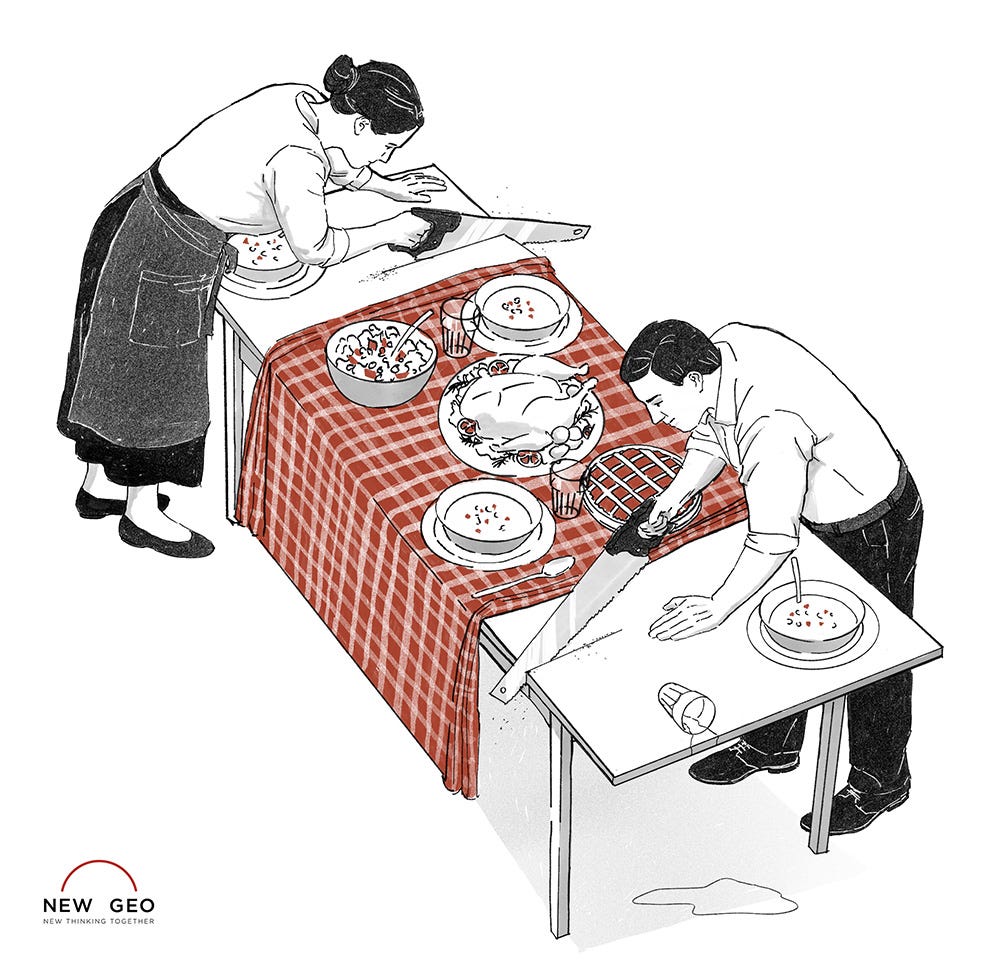
Is public participation waning?
“Faith in the system” is not just a feel-good vibe. It’s the fuel that helps us get where we want to go, together.
Our own expectations of the system’s capacity to deliver tend to be a self-fulfilling prophecy. If I trust the police, then when they launch a new neighbourhood watch programme, I will do my part, which helps the programme deliver its intended results, which builds my trust in the police. If I don’t trust them, I likely won’t participate, so the programme fails to deliver, so I trust them even less.
Across public services, trust plays this pivotal role in the improvement or collapse of social goods and services, and it is earned or lost in feedback loops just like with that neighbourhood watch.
It’s these dynamics between expectations and reality that make survey evidence of declining public trust so concerning. The Edelman Trust Barometer gets cited endlessly on this topic, because the annual survey’s results are stark and serious:
Fears that government and business leaders lie to us are at an all-time high, with more than two-thirds of people surveyed in 2026 doubting that they speak the truth. It’s even starker for journalists: 70% believe that reporters purposely mislead people.
Public trust is falling across the world’s democracies, and the more it falls, the harder it will be to win back. Over half (53%) of people aged 18-34 support “hostile activism”, defined as supporting one or more of the following if it drives change towards what they see as a better future: attacking people online, intentionally spreading misinformation, threatening to or committing violence, or damaging public property. While the numbers are higher among young people, 40% of all respondents were favourable to such activism [4].
Assaulted by alternatives
Democracy is struggling to adapt to a citizenry whose sense of reality diverges ever more widely. Meanwhile, authoritarian governance is gaining appeal within the liberal democratic heartland—within those same societies (France, the US, the UK) that set the modern template for ‘rule by the people’. Part of the appeal is a product of popular exasperation: the system is broken, the usual choices don’t make a discernible difference, so yeah, let’s turn to radical alternatives to shake things up.
But also: populists thrive in simplified realities. Our information ecosystem is handing out candy—simple truths that confirm my existing biases. It’s already dampening our will to search for something truer. Now along comes a populist, who gives me permission to embrace my preferred way of seeing things without guilt—with pride, in fact [5]. To follow a populist leader is to be touched by an alchemist. They transmute my own self-serving truth into a mark of enlightenment that others have not yet attained.
A sobering list
In short, the “ledger of harms” is long [6]. When common knowledge fails, everything built atop it begins to fail, too.
Until next time…
Next post, we’ll turn from the ledger of harms to the survey of solutions. What all is already being done, to shore up common knowledge for the sake of our sanity, science, and society? And why isn’t it enough?
For here and now:
Where has a decision in your world broken down because people didn’t share the same facts? What happened?
This has been post #3 in the chapter Common Knowledge is Collapsing.
Share research: ubd@newgeo.org
Further Reading
[1] Andres Reiljan on affective polarisation: Causes, impacts and solutions
[2] Lanteigne, Stünkel, Andrijauskas, Jakobsson, and Okholm - China’s Influence in the Nordic – Baltic Information Environment: Denmark and Lithuania
[3] Roberto Foa - Faith in democracy: millennials are the most disillusioned generation ‘in living memory’
[4] 2025 Edelman Trust Barometer
[5] John Burn-Murdoch - Welcome to the age of zero-sum politics
[6] Center for Humane Technology – Ledger of Harms