


Already, we’re drowning in content masquerading as evidence.
The question at the heart of a well-examined life—of critical self-reflection—is shifting: from “What should I believe?” to “Where did that belief of mine come from?” And provenance is becoming the new common sense.
What does it take today for you to treat a photo, quote, or “expert claim” as real enough to act on?
Uncertain by Design (UbD) is a deep research series for leaders who value inquiry over certainty – and want to shore up our shared reality.
Catch up here • Share research: ubd@newgeo.org
Shared reality as strength
When we can’t agree on what’s real, we can’t coordinate—can’t compromise, can’t sacrifice, can’t commit.
That’s the hidden constraint on collective strength: not what we can do, but what we can do together.
United we stand; divided we fall. This proverb has a history stretching all the way back to Aesop’s Fables, but it takes on fresh meaning—and urgency—amidst the collapse of common knowledge today.
We are stronger together—but only if we can manage to get ourselves together. The first limiting factor on a people’s collective strength is not the limit of their military might or technological prowess; it’s the limit of their shared reality.
Hail the solutioneers
This is hardly the first time in human history that an information revolution has turned the world upside down. Each time before—when we shifted from scribes to print, from print to radio, from radio to TV, from TV to the internet, and so on—we adapted new patterns of attention, authority, and agency.
So, we’ve learned what it takes to adapt well: preserve what is essential, let go of what no longer serves us, and embrace what is better.
This time, a truly global effort has arisen to help us all make the transition. Across the whole epistemic value chain—from the creation of knowledge, through its circulation, to our reception of it—brilliant and brave people, inspired by the gravity of the threat, are defending our capacity to think and do together.
Securing the Origins of Truth
The traditional makers of verifiable truth are working hard to make the difference between what is verified and what is viral more plain for all to see.
Proving provenance
The effort to make what’s authentic more obvious begins with the frontline tools humans use to capture and document reality: our smartphones, cameras, and word processors.
One leading effort—the Coalition for Content Provenance and Authenticity (C2PA)—has major toolmakers (e.g., Canon, Sony, Adobe) and platform providers (Microsoft, Google) working together to develop open standards for verifying the origin and integrity of digital media [1]. The goal is to embed tamper-evident metadata into every image, video, or document, so that its whole editing history is logged and traceable all the way back to the device that created it.
Meanwhile, OpenAI, Google, and others are researching how to flag AI-generated digital media as exactly that: AI-generated. Google DeepMind’s SynthID (under development) does it by embedding watermarks—imperceptible to humans but unmistakable to detection software—into AI-generated imagery, audio, video, and text. Of the four, flagging text is the hardest—as every teacher grading essays today knows—because it’s very hard to keep proof of provenance intact across multiple copy-pastes and re-edits [2].
“But the trajectory is unmistakable. We are building a future where understanding media—what it is, how it was made, and by whom—becomes a basic part of digital literacy. Where truth is defended not by claims, but by verifiable context. Where trust is supported by systems designed to endure through the rapid ascent of generative media, and beyond” [3].
Authenticating academic work
Valuable territory, weakly defended
Peer-reviewed academic research is valuable territory, weakly defended.
Leading journals and universities are working hard to change that.
In theory, any published academic research should be reproducible. That’s what makes its findings “something true about our world” rather than “one person’s opinion”. Peer review is the process that polices this standard. The reliability of academic knowledge rests on its shoulders [4].
The incentives to cheat this system are strong. Once a paper gets stamped with the “peer-reviewed” seal of authenticity, it becomes more than an article. For the author, it becomes an asset: evidence of expertise; influence in academic hiring decisions; persuasion in public policy decisions; more money from foundations. For the field of study, it becomes part of the corpus of knowledge–something that others cite, depend upon, and build upon.
The opportunities to cheat the system are obvious. Peer-review is great in theory but labour-intensive in practice. Peers hardly ever have time and resources to actually rerun someone else’s research and verify the results. The volume of new submissions overwhelms the capacity of every academic discipline to check quality.
So, most peer review is really a sense-check: Is this new result so strange to me that I’m going to expend the effort to rebut it?
More often than not, the answer is “No”.
Through the 2010s, while social media was flooding our newsfeeds with unverified “truths”, profit-motivated research was flooding our science with suspect findings.
A playbook emerged to exploit every weak point in the peer-review system on an industrial scale. In this “paper mill”: data is fabricated; text is recycled; authors collude in rings where they guaranteed to cite one other and signed off on each other’s research; peer reviews are faked. A 2023 analysis in Nature ([5]) estimated that 1.5–2% of global scholarly output in the previous year betrayed the patterns of the paper mill—i.e., tens of thousands of articles.
Academics to the ramparts
Now, just as generative AI threatens to supersize the problem, leading journals and universities are fighting back. The paper-mill playbook has been exposed, and the loopholes it exploits are shrinking. Authors now need to share more data more openly and pass more pre-publication checks. Major publishers like Elsevier, Springer Nature, and Wiley are sharing blacklists and “suspicion signals”, so that each publisher’s policing effort now casts a wider shield of integrity [6]. Peer review is raising its game, through tighter qualifications and stronger editor training. AI is helping to scale up detection of plagiarism and data manipulation. “If we see untrustworthy content [from a scholar] that you’re not retracting, you’re not getting back in” (Nandita Quaderi, Editor-in-Chief of Web of Science and Co-Chair, United2Act Against Paper Mills) [7].
The ivory tower is refitting itself as a fortress.
Fortifying the fourth estate
Mainstream journalism is embarked on a broad-spectrum effort to compete for public belief, now that they’ve lost their monopoly power to declare what’s real.
A first step in that effort has been to increase transparency: labelling news versus opinion more clearly; disclosing potential conflicts of interest more prominently. In the judgment of some outlets, like The Guardian, taking conflicts of interest seriously has meant shifting the whole business model: from ad-based revenues (which drives a publisher to pump out clickbait) to subscriber-based revenues (where winning is more about exercising good editorial judgment and delivering consistent value over the long term) [8].
Winning public belief also means playing up journalism’s competitive advantage: sharing primary documents, data, and methods with the public alongside the published piece, to make more glaring the difference between a story that came out of their newsroom and a story that came out of a basement [9].
But the biggest and best-known journalistic effort to secure the origins of truth is fact-checking, which over the past decade has grown into a global industry. Fact-checkers have their own professional body since 2015, the International Fact-Checking Network. It publishes standards and issues credentials, so that we the public can sort those fact-checkers who abide by a code of practice from those people who just call themselves fact-checkers to cast doubt upon facts they don’t like. Critics (including, now, Meta’s Mark Zuckerberg) claim that fact-checkers skew public discourse by dampening the content they don’t like. But “Far from censoring, fact-checkers add context. We never advocate for removing content. We want citizens to have better information to make their own decisions” (Laura Zommer, Latin American fact-checking pioneer and co-founder of Factchequeado) [10].
And again, “AI for good” is part of the solution here, both to dampen the spread of misinformation and make verified knowledge more accessible. AI webcrawlers can scan massive volumes of content autonomously, flagging false claims or detecting stories that have already been debunked. AI explainers can take an important-but-dense policy document, like the latest IPCC climate report, and quickly generate tailored presentations to different audiences—in different languages—to convey the information it contains.
Besieged but not beaten, the best newsrooms of the fourth estate are leading their profession’s transition from privileged gatekeeper to trusted learning partner.
Until next time…
Next time: propagation. How to circulate the truths that serve—without rewarding the ones that harm?
This time: provenance. I’d love to hear:
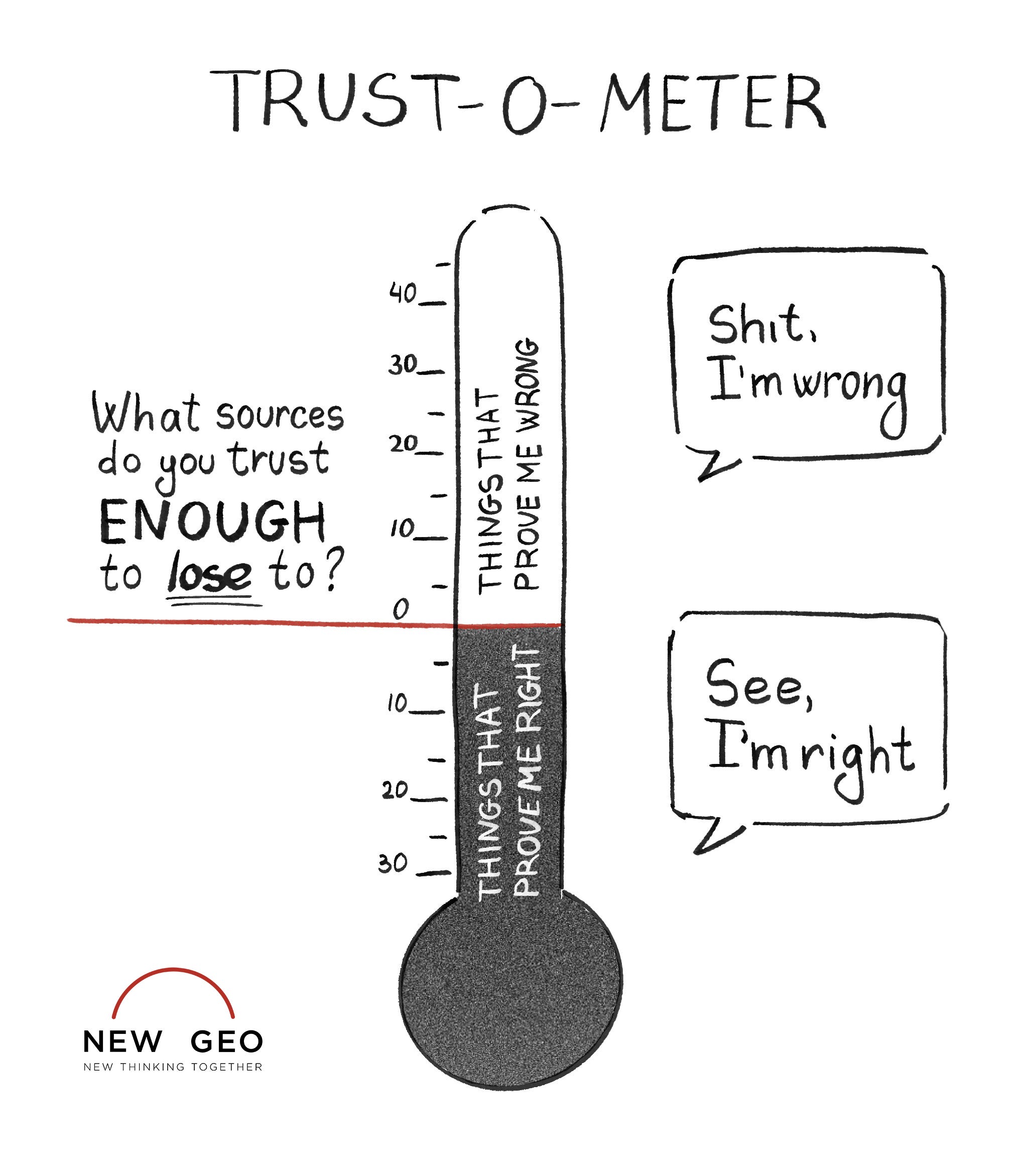
What would you trust enough to lose to? In other words: what evidence, from whom, would you accept—even if it cost your side the point? (Reply here or email a short story: ubd@newgeo.org)
This has been post #4 in the chapter Common Knowledge is Collapsing.
Catch up here • Share research: ubd@newgeo.org
Further Reading
[1] C2PA – White Paper
[2] Alice Speri - ‘I wish I could push ChatGPT off a cliff’: professors scramble to save critical thinking in an age of AI
[3] Andy Parsons - The State of Content Authenticity in 2026
[4] Benjamin Mazer - The Peer-Review Dilemma
[5] Richard van Noorden - How big is science’s fake-paper problem?
[6] Joe Wilkins - Academics in Meltdown Now That They’re Responsible for AI Hallucinations in Their Research Papers
[7] The Economist - Fraudulent scientific papers are booming
[8] Charlotte Tobitt - Times ‘fewer, better stories’ strategy leads to run of audience growth
[9] The New York Times – Visual Investigations
[10] Huo Jingnan & Shannon Bond - Meta built a global fact-checking operation. Will it survive?